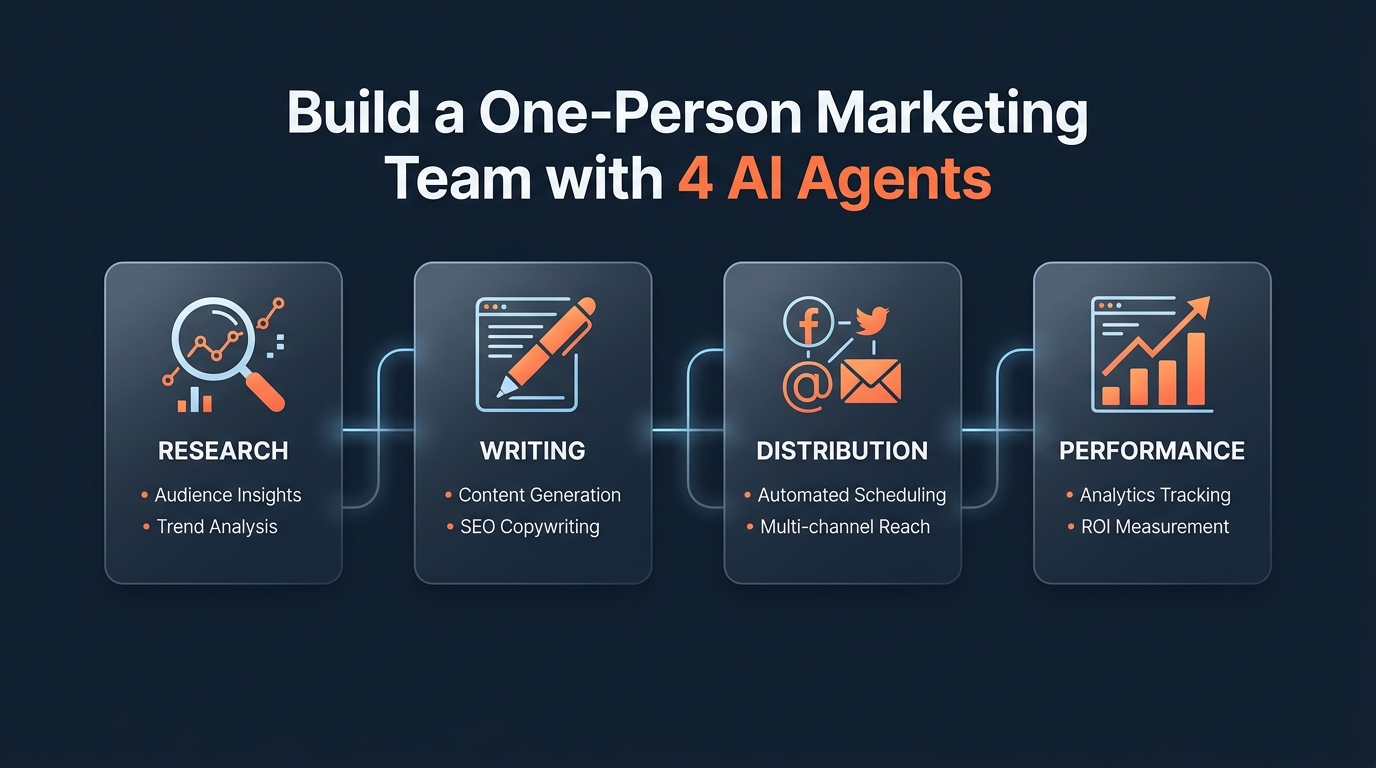
Every channel gets 20% of your attention, which means every channel gets 20% of the results. The answer isn't working harder or hiring an expensive agency. It's building a system of 4 specialized AI agents with a defined role, loaded brand context, automated triggers, and concrete delivery destinations.
A blog post one week. A LinkedIn push the next. A newsletter when you remember. Analytics when something breaks.
And the answer isn't working harder. It isn't hiring either. Not yet.
It's building a team that doesn't need salaries, sick days, or a bloated Slack channel. A team of AI agents. Not a chatbot you ask for "10 blog ideas." Not a tool you open once a week.
Agents. Systems with a defined job, clear inputs, a repeatable process, and an output that lands somewhere useful without you babysitting it. Four of them can cover most of what a small marketing team does.
Let's build them.
First: What Makes Something an "Agent" (and Not Just a Prompt)
This distinction matters. Most people use AI like a vending machine. Put in a prompt, get a snack, walk away. That's not a team member. That's a tool.
An agent has four critical components:
- A role: One clearly defined job, written like a job description.
- Context: Your brand voice, audience, offers, and past work, loaded in every single time.
- A trigger: Something that kicks it off: a schedule, a new file, a form submission, or a new row in a sheet.
- A destination: Its output goes somewhere actionable: a doc, a draft queue, a Slack channel, or your inbox.
Read that again.
If you're copying and pasting between tabs, you don't have an agent. You have a very expensive intern who forgets everything overnight.
You can build these with a Claude Project or a custom GPT for the thinking, and an automation tool like Zapier, Make, or n8n for the triggers and hand-offs. No engineering degree required.
The Research Analyst
Every good marketing decision starts with knowing something your competitors don't. Most solo marketers skip this step—not because they don't value it, but because it takes hours they simply do not have.
Your Research Analyst's job: Tell you what your market is talking about, every week, without you asking.
Inputs to Feed It
- Competitor blogs, newsletters, and LinkedIn profiles.
- Subreddits, Discord groups, and forums where buyers congregate.
- Sales call transcripts, support tickets, and email replies.
Weekly Deliverable
- Top 5 questions your audience keeps asking.
- Competitor content angles and whitespace gaps.
- 3 high-opportunity content angles ranked by demand.
This one agent changes everything downstream. Because now you're not guessing what to write. You're responding to verified demand.
The Content Strategist-Writer
This is where most people start with AI—and it's where most people fail. Why? Because they ask a blank model to "write a blog post about X." They get generic, soulless copy that sounds like every other AI-written post on the internet. Then they conclude AI can't write.
AI can write. It just can't write you without being taught.
Foundation Assets
- Brand voice guide with examples of your best-performing copy.
- A blacklist of cliches, buzzwords, and banned phrases.
- Detailed ICP profiles: fears, buying triggers, aspirations.
- Hard proof points: verified numbers, case metrics, quotes.
Standard Operating Procedure
- Ingest the Research Analyst's recommended angle.
- Generate a comprehensive outline for founder sign-off.
- Draft the full piece to the approved structure.
- Run an internal self-audit against your voice guide.
Notice what just happened. You moved from writer to editor. That is the single biggest time unlock in this entire system.
One vital rule: You always add the part only you can add. A real founder anecdote. A client battle scar. An opinion someone might disagree with. That's what makes content worth reading.
The agent does 80% of the heavy lifting. You do the 20% that makes it resonate.
The Distribution Manager
Here is where good content goes to die. You spend six hours on a blog post. You share it once on LinkedIn. It gets 40 likes. And that's the end of its life.
Publishing is not distribution. A full marketing department squeezes every drop out of that asset. Your Distribution Manager does the exact same thing.
From one cornerstone article, it produces:
- 3 to 5 LinkedIn posts: Each built around an independent insight or chart.
- A newsletter section: Teaser hook, key takeaway, and direct link.
- A short X/Twitter thread: Concise breakdown for viral reach.
- A carousel script: Structured slide-by-slide visual layout.
- A short-video script: 60-second script for Reels, Shorts, or TikTok.
- A tailored email: Outreach angle for relevant prospects or active accounts.
One piece of content. Ten touchpoints. That's how a team of one starts to look like a team of five.
The Performance Analyst
This is the agent almost nobody builds—and it's the one that makes the other three exponentially smarter over time.
Most solo marketers check analytics when they feel anxious. Then they stare at complicated dashboards, feel vaguely guilty, and close the tab. No decisions. No structural iterations. Data you don't act on is just decoration.
Your Performance Analyst's job: Tell you what worked, what fell flat, and what to do next in plain English.
Data Feeds
- Google Search Console & Analytics (GA4).
- Native social platform engagement metrics.
- Email opens, clicks, and reply rates.
- CRM or lead sheet conversions.
Monday Briefing
- Top 3 performing assets and the underlying hook mechanics.
- Bottom 3 underperformers with specific fixes.
- Which channels actually drove qualified leads, not vanity clicks.
- One concrete growth experiment to run this week.
Then close the loop: Feed that Monday report right back into the Research Analyst and the Writer.
Now your system learns. Every week, the content gets a little sharper. The distribution a little more targeted. That's not automation—that's compounding leverage.
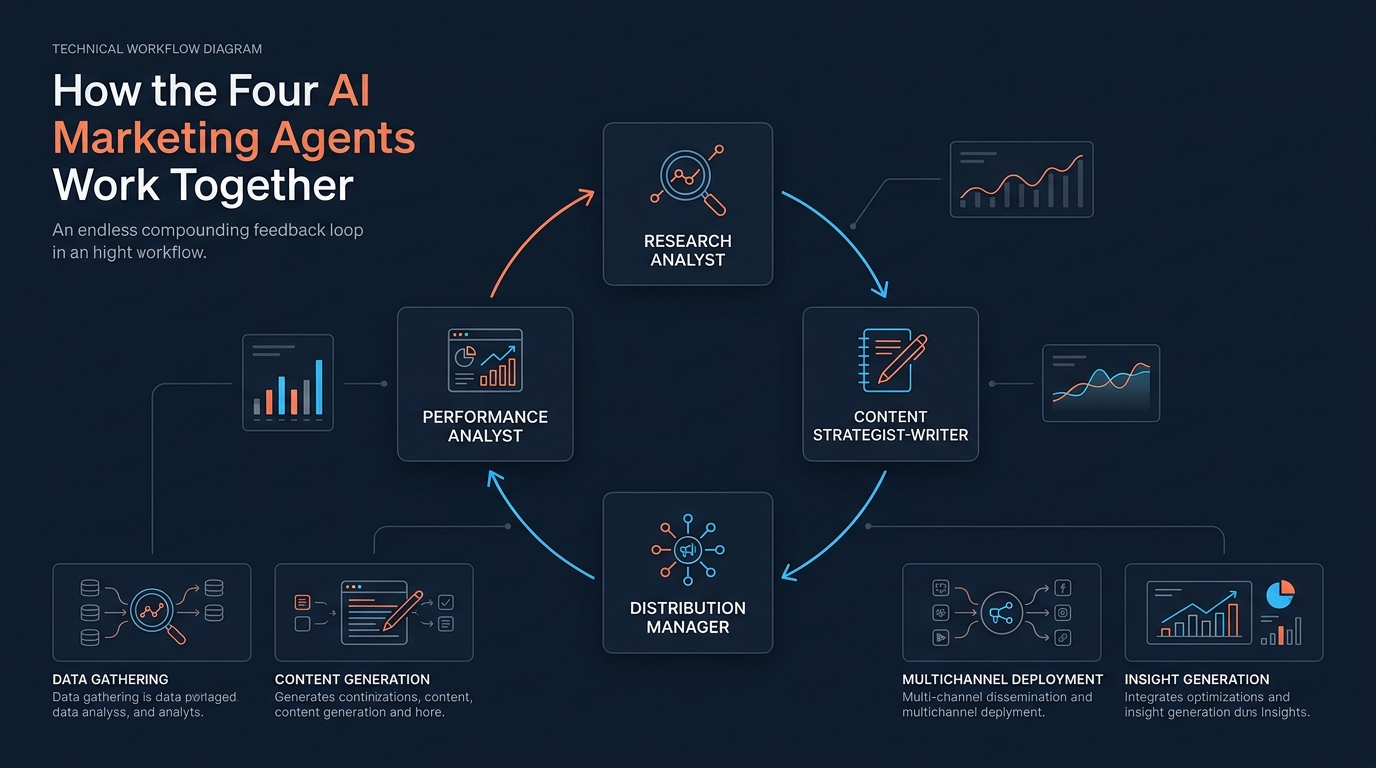
How the Four Agents Work Together: The Weekly Operating Cadence
Here is the exact operating schedule our founders run every week:
Intelligence Briefing: Performance Analyst evaluates the prior week's results. Research Analyst submits this week's topical brief.
Angle & Outline: You select 1 recommended angle. The Writer produces the outline; you approve it in 5 minutes.
Draft & 20% Polish: The Writer delivers the full draft. You inject your personal perspective, numbers, and publish.
Multi-Channel Atomization: Distribution Manager generates 10 native channel assets. You review and queue them in one sitting.
Human Connection: Community engagement, prospect direct messaging, and sales calls—the work AI cannot replace.
Roughly 5 to 8 hours per week total. For output, consistency, and reach that previously required a $20,000/month 5-person agency.
The 4 Mistakes That Break the System
Plenty of founders try this and abandon it within two weeks. Almost always, it comes down to four critical missteps:
- Zero Context: Agents deployed without brand voice, buyer profiles, and benchmark examples produce generic mush.
- No Human Review Step: Publishing unedited AI output erodes trust at lightning speed. Tone drifts, and hallucinations sneak through.
- Too Much, Too Soon: Attempting to build and wire all four agents in a single weekend leads to burnout and broken automations.
- No Feedback Loop: Without the Performance Analyst feeding intelligence back in, you are simply automating guesswork.
The fix is straightforward: Build one agent at a time. Start with the Writer if content production is your primary bottleneck. Start with the Distribution Manager if you already have great articles but zero reach. Get one running smoothly before adding the next.
The Bottom Line
Let's recap your autonomous one-person marketing team:
- Research Analyst: Tells you what to create based on live market demand.
- Content Strategist-Writer: Creates high-fidelity drafts in your unmistakable voice.
- Distribution Manager: Atomizes and distributes your message across all channels.
- Performance Analyst: Uncovers what converted and feeds that intelligence back into the engine.
None of these replace your judgment. They replace the repetitive manual labor that was burying it.
The question isn't whether AI will change how small teams do marketing. It already has.
The question is whether you're still doing everything yourself—or directing a team that works while you think.
Want Bootsolo to wire your 4-agent growth engine?
We design, train, and deploy custom autonomous marketing infrastructure tailored to your exact ICP and positioning.